





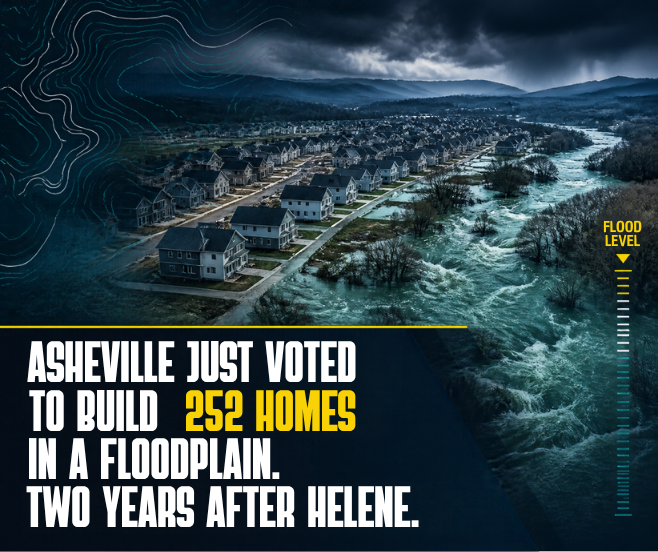
On Tuesday, October 27, Asheville City Council voted 4 to 3 to approve a seven-story, 252-unit apartment complex at 21 London Road, near Biltmore Village. The vacant 2.63-acre lot sits directly beside Sweeten Creek, and part of the lot lies within the creek's 100-year floodplain.
It was Council's first vote on a new construction project in the city's floodplain since Tropical Storm Helene. The closeness of the vote, and the debate that came before it, tells a story that matters well beyond one apartment project. Anyone buying, selling, or renting a home near water in Buncombe County is living with the questions Council wrestled with that night.
What Council actually approved
This site has a history. In May 2024, before Helene, Council approved a six-story, 208-unit complex on the same lot. The project approved last week is larger: seven stories and 252 homes.
The building is designed with flooding in mind, at least in its basic shape. The first two floors would hold a lobby and parking rather than homes, so the apartments themselves start on the third floor. The project's attorney offered no timeline for breaking ground or for the first residents moving in.
Mayor Esther Manheimer noted that tighter rules for building in the floodplain may be coming, but not soon. In September, Council approved a $1.4 million contract with a design firm to help overhaul the city's nearly 30-year-old development rules, and the mayor said revised rules likely will not be ready for approval until the end of 2028. Until then, projects are judged under the current rules, one at a time, which is how this one arrived at a 4 to 3 vote.
A split that sounds a lot like our neighbors
The three members who voted no, Kim Roney, Sage Turner, and Maggie Ullman, said the developer's flood resilience plans were too vague to earn confidence. Roney had voted for the earlier version of this project in 2024 and changed her vote after Helene, saying the storm brought new information. Her words from the meeting: "It floods here. It floods more often than every 100 years, and the waters rise."
The four who voted yes, Mayor Manheimer, Vice Mayor Antanette Mosley, and Council members Sheneika Smith and Bo Hess, pointed to a city that needs homes and to private investment willing to build them. Hess, who made the motion to approve, put the risk argument this way: "For every business, there's a risk to it."
Both sides are describing real things. Asheville does need housing, badly, and this region's creeks and rivers do flood, now with a fresh disaster in living memory. The disagreement is over how much flood protection is enough, and who should have to prove it, and when.
What "100-year floodplain" really means
This phrase misleads more buyers than almost any other term in real estate, so let us be plain about it.
A 100-year floodplain is not land that floods once every hundred years. It is land with a 1% chance of flooding in any given year, according to FEMA, the agency that draws the maps. That risk does not reset after a flood, and it adds up: a home in the 100-year floodplain has about a 26% chance of flooding at least once over the course of a 30-year mortgage.
Two more things follow from that. First, flood maps are estimates drawn as lines, and water does not read maps. Homes outside the mapped floodplain flood too, a fact Helene demonstrated across this county. Second, being inside the line carries legal and financial weight that being just outside it does not, which brings us to insurance.
The insurance facts every buyer near water needs
A standard homeowners policy does not cover flood damage. Rising water is excluded, plain and simple. Coverage for flooding comes only from a separate flood policy, either through the National Flood Insurance Program run by FEMA or through a private flood insurer.
For many buyers, flood insurance is not optional. If a home sits in a designated high-risk flood area and the buyer uses a federally backed mortgage, federal law requires flood insurance for the life of the loan. That premium becomes part of the true monthly cost of the home, and it belongs in the budget before an offer, not after one.
Timing matters. Most new flood policies through the national program have a 30-day waiting period before coverage begins, with limited exceptions such as a purchase at closing. A buyer who waits until the week of closing to ask about flood insurance may already be late, which is one more reason the homework belongs in the due diligence period.
Renters are not covered by a landlord's policy. The future residents of the London Road apartments, and renters everywhere near water, need a contents policy of their own if they want their belongings protected. A building policy covers the building, not the furniture, clothing, and electronics inside a rented home.
North Carolina sellers have to answer flood questions in writing
Since a recent update to the state's Residential Property and Owners' Association Disclosure Statement, flood questions are no longer buried. The form asks sellers directly:
Is the property located in a federal or other designated flood hazard zone?
Has the property had damage from flooding, water seepage, or pooled water from a natural event?
Has the owner ever filed a claim for flood damage, including with the National Flood Insurance Program?
Is there a current flood insurance policy on the property?
Has the owner received FEMA or other federal disaster assistance for flood damage?
For sellers near a creek or river, those answers, plus supporting paperwork such as an elevation certificate, flood insurance records, and receipts for mitigation work, are now part of what a buyer is buying. A seller who can document elevation, drainage work, or a history of staying dry has something real to sell. A seller who cannot answer the questions clearly gives buyers a reason to move on to the next listing.
For buyers: five questions to ask about any home near water
What flood zone is the home in, and what is its elevation compared with the base flood elevation? FEMA's Flood Map Service Center and the state's Flood.NC.gov site both allow an address search, and an elevation certificate answers the question precisely.
What does flood insurance cost on this specific home? Get a quote during the due diligence period. Price varies by elevation and risk, and the answer changes what the home really costs each month.
What do the disclosure answers say, and what paperwork backs them up? Compare the flood answers with any FEMA assistance, claims, or repair records the seller can share.
Where does water go on this lot? Visit after a heavy rain if the chance comes. Look at drainage, driveway slope, crawl space, and where the creek or ditch sits relative to the home, not just relative to the property line.
How do residents get in and out during high water? A home can stay dry while the road to it does not. Access during a flood matters for safety, for work, and for resale value later.
The housing need on the other side of the vote is real, too
None of the above erases why four Council members voted yes. Our latest Canopy MLS numbers, reported November 3, show 2,168 homes for sale in Buncombe County, a regional median sales price of $410,000, and 6.6 months of supply, with 75 county homes sold in the last seven days. Those figures describe a for-sale market that has loosened, but a median price of $410,000 still leaves renting as the only option for many people who work in Asheville. New apartments near jobs and transit lines answer a need that the for-sale market is not answering, and 252 rental homes beside a creek are one version of that answer, with the flood questions built in from the first day of design.
The bottom line
The London Road vote is not the end of this decision. It is the start of a pattern. Until Asheville's updated building rules arrive near the end of 2028, floodplain projects will keep coming before Council one at a time, and each one will force the same argument between housing need and flood memory.
For the rest of us, the practical lesson is simpler. In western North Carolina, water is now a standard part of buying and selling a home, on the same level as the roof, the septic system, and the road frontage. Buyers who ask the flood questions early, and sellers who can answer them with documents, will do fine. The ones who treat the flood map as fine print are the ones taking the real risk.
If a home near a creek, river, or low-lying road is on the table, buying or selling, we are happy to walk through the flood zone, the disclosure answers, and the insurance questions before an offer is written. That homework is a big part of guiding people home in a county that has seen what water can do.

