



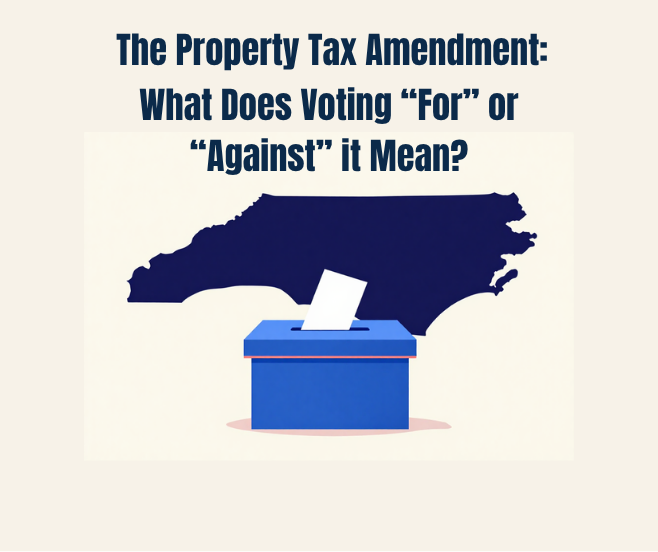
One short sentence near the end of the November ballot will shape how Buncombe County, Asheville, Black Mountain, and every other local government in North Carolina can pay for services for years to come. The sentence is easy to read and easy to misunderstand, and a lot of the discussion around it has filled in details that are not actually in the measure.
So here are the facts, in plain language, with sources at the end: the exact wording voters will see, the exact sentence that would be added to the state constitution, what the amendment would do, what it would not do, what each side is arguing, and the Buncombe County numbers that show why this vote matters here.
No recommendation follows. Readers will land on different sides of this question, and reasonable people already have. What follows is the record, so neighbors can decide with the same set of facts in front of them.
At a glance
The vote: Tuesday, November 3, 2026, with early voting already underway through Saturday, October 31.
The question: whether to add a requirement to the North Carolina Constitution that the General Assembly pass laws limiting how much local governments can increase property tax collections.
The number in the amendment: there is none. The amendment sets no percentage, no dollar figure, and no cap of any kind. Lawmakers would choose the limit later, by ordinary state law.
What it limits: the total levy, meaning the total dollars a county, city, or town collects, not the tax rate and not any individual tax bill.
What changes the day after the election: nothing about any tax bill. If the amendment passes, the real decisions move to the General Assembly in 2027.
How it got on the ballot: House Bill 1089, now Session Law 2026-5, passed the state House 73 to 46 and the state Senate 31 to 15 on May 20, 2026. A proposed amendment needs a three-fifths vote in each chamber to reach the ballot, and then a simple majority of voters to pass.
The exact words on the ballot
Voters will mark one of two boxes:
[ ] FOR
[ ] AGAINST
Constitutional amendment requiring limits on property tax increases by local governments.
That is the whole question as voters will see it. The official summary prepared by the Legislative Services Officer of the General Assembly says the same thing in one line: "This amendment to the North Carolina Constitution would require the General Assembly to set limits on property tax increases by local governments."
The exact words that would go into the constitution
If a majority votes FOR, one sentence is added to Article V, Section 2(5) of the North Carolina Constitution:
"The General Assembly shall enact general laws limiting the amount by which the levy of taxes on property may increase, which may include exceptions."
Every important detail hides in that sentence. The requirement would be permanent until voters amend the constitution again. The limit itself, whatever it turns out to be, would be ordinary state law, which a future legislature could adjust. And the phrase "which may include exceptions" means lawmakers could carve out exceptions, for emergencies or anything else, if they choose to.
What a FOR vote does, and what an AGAINST vote does
A FOR vote adds the sentence above to the constitution. The General Assembly would then be required to pass laws that limit how fast the total property tax levy of each local government can grow. The formula, the percentage, any adjustment for inflation or population growth, the treatment of revaluation years, and the exceptions would all be decided in that later legislation.
An AGAINST vote leaves the constitution as it is. County commissioners, city councils, and town boards would keep setting property tax rates through their local budget processes, subject to the state laws that already apply, and the General Assembly would remain free to pass levy limits by ordinary law if a future legislature wants them, without being required to.
Five things this amendment does not do
This is the section worth sharing, because most of the confusion about this measure lives here.
1. It does not set a 2% cap. The 2% figure showing up in articles and campaign material is not in the amendment. It comes from a modeling exercise by the North Carolina Housing Coalition, which asked what would have happened if a 2% levy limit had been in place during the last revaluation cycle. That study is useful for understanding the size of the tradeoffs. It is not the law voters are being asked to approve, and no one should vote assuming 2% is the number.
2. It does not cap any individual tax bill. As NC State accounting professor Nathan Goldman explains in his analysis of the amendments, a levy limit restricts how many total dollars a county or city can raise. A homeowner's own bill can still rise or fall, because bills depend on the tax rate and on the assessed value of that home compared with its neighbors, especially in a revaluation year.
3. It does not cap the tax rate. A rate cap and a levy limit are different tools. This amendment calls for a levy limit, a cap on growth in total dollars collected. Local governments could still raise or lower rates, as long as total collections stayed within whatever limit the legislature sets.
4. It does not cut any tax this year. Analysts across the spectrum agree on this point. The amendment changes who gets to make future tax decisions and how much room they have. It does not lower a single bill in 2026, and if it passes, the limits themselves would not exist until the General Assembly writes them.
5. It is not Proposition 13. California's famous measure limits the growth of each property's assessed value and resets the value when a home sells. The North Carolina proposal does neither of those things. It works at the level of a whole county or town budget, not at the level of an individual home, and buying or selling a home has no special effect under it.
The case for a FOR vote, in supporters' own terms
Supporters, led by the Republican majority that placed the measure on the ballot, argue that local property tax collections have grown faster than family budgets and that voters should put a guardrail in the constitution itself.
House Speaker Destin Hall, a lead supporter, says the amendment would stop "runaway property tax hikes" and protect North Carolina taxpayers. Senator Tim Moffitt, a western North Carolina sponsor, argued during debate that some local governments have imposed high tax rates with little regard for fiscal restraint, and that local governments should face fiscal limits similar to the ones the state accepts.
The strongest number behind the FOR case comes from the John Locke Foundation, which found that over the past decade, the state's 10 largest counties collected $2.6 billion more in property tax than they would have collected if growth had been limited to the combined pace of inflation and population growth. Supporters read that figure as proof that collections, left alone, drift well beyond what it costs to serve a growing population.
Sponsors also point out that North Carolina would not be experimenting. Representative Brian Echevarria, a primary sponsor, noted during debate that 22 states already limit local levies in some form, and argued that services in those states continue to function.
The case for an AGAINST vote, in opponents' own terms
Opponents argue that the amendment asks voters to sign a permanent constitutional requirement before anyone has seen the actual limit, and that the limit, once in place, would tie the hands of the local officials closest to the services the money pays for.
That argument arrived in Buncombe County on October 20, when the Board of Commissioners voted unanimously to adopt a resolution formally opposing the amendment, the first time the county government has taken a formal position against a proposed state constitutional amendment. Buncombe joins at least five other counties, including Durham and Orange, that have passed similar resolutions this year.
Board Chair Amanda Edwards put the local control argument plainly: "This is another example of Raleigh doing something to us that, as 100 counties, we did not ask for." Commissioner Drew Ball, who pushed for the resolution, pointed to Tropical Storm Helene: "Helene showed us why budget flexibility in order to respond to extraordinary circumstances ... is really, really important."
Commissioners also raised two practical worries: that limits could push costs toward fees and other charges that fall harder on lower income residents, and that uncertainty about future revenue could raise the county's borrowing costs. The League of Women Voters opposes the measure on similar grounds, arguing that it shifts local budget authority to Raleigh without stating the limits or the exceptions in advance. Governor Josh Stein also opposes both tax amendments on the ballot.
The strongest number behind the AGAINST case comes from the North Carolina Housing Coalition study described above. Under its hypothetical 2% levy limit, local governments across North Carolina would have lost more than $950 million in revenue during the period studied, while the average homeowner would have saved about $84 a year. The same study found that the largest dollar savings would have gone to the state's largest corporate landowners rather than to homeowners. Supporters dispute what a study of a limit nobody has proposed can prove, and that dispute is exactly the point voters have to weigh: the real limit has not been written yet.
Why this hits Buncombe County harder than most places
Property taxes are not a side revenue source here. They are the county budget.
Roughly two-thirds of Buncombe County's general fund came from property taxes last fiscal year, about $287 million.
This fiscal year, property tax revenue makes up 69% of the county's general fund revenue, and the county budget projects property tax revenue of about $335 million, a jump of about 16% from last year.
Property taxes also support nearly a third of K-12 education funding in the county, according to NC Budget and Tax Center analysis cited at the October 20 meeting.
This year, commissioners raised the county property tax rate from 54.66 cents to 61.54 cents per $100 of assessed value, while continuing to use 2021 property values after the legislature delayed use of the county's 2026 revaluation. Whatever side of this debate a reader is on, that sequence is a fair example of the growth supporters want to restrain and of the budget pressure opponents say local boards cannot escape.
Those services are the everyday ones: schools, sheriff and emergency response, libraries, parks, public health, and the recovery work still underway after Helene. A levy limit would not set funding for any of them directly. It would set the ceiling on the revenue that pays for all of them, and the county would budget underneath it.
What nobody can tell voters yet
An honest reference post has to name the unknowns, because on this measure the unknowns are the decision:
The percentage or formula of the limit: a flat percentage, inflation plus population, or something else entirely.
Whether unused room under the limit in one year carries forward to later years.
How revaluation years are treated, which is when bills shift the most.
Which exceptions exist, if any: natural disasters, voter approved levies, debt payments, new construction, or emergencies.
When the limits would first apply.
As Professor Goldman puts it: "The growth formula, any exceptions and the treatment of revaluation years will decide whether this is a modest guardrail or a binding constraint on local budgets." If the amendment passes, those questions get answered in Raleigh in 2027, and they are worth following as closely as the vote itself.
Where voters stand, as of the last statewide poll
An Elon University Poll of 800 likely voters, conducted August 21 to 31, 2026, found 72% in favor of the property tax amendment, 14% opposed, and 14% unsure, with a margin of error of plus or minus 5.5 percentage points for likely voters. A separate Catawba College and YouGov survey found support starting just as broad across party lines, then dropping noticeably for every group once voters heard the arguments on both sides, including the argument that financially struggling counties could be forced to cut services. Short version: the headline idea polls very well, and the details move people. That is a good reason to read the details before voting, whichever conclusion a reader reaches.
How and when to vote on this question
Early voting runs through Saturday, October 31, 2026 at 13 sites across Buncombe County. Weekday hours are 8 a.m. to 7:30 p.m., and hours on the final day, October 31, are 8 a.m. to 3 p.m. Any Buncombe voter can use any early voting site, and same-day registration is available at early voting sites.
Election Day is Tuesday, November 3, 2026. Polls are open 6:30 a.m. to 7:30 p.m., and anyone in line at 7:30 p.m. will be allowed to vote. On Election Day, voters must use their assigned precinct location.
Bring photo ID. North Carolina voters are asked to show an acceptable photo ID. Voters without one can complete an ID Exception Form, and free voter photo IDs are available from Buncombe County Election Services.
See the exact ballot before going. The NC State Board of Elections Voter Search tool shows each voter's sample ballot, registration, and assigned Election Day polling place. Buncombe County Election Services can be reached at 828-250-4200.
The bottom line
Strip away the campaign language and this vote comes down to one question: how much discretion should future legislatures and local governments have over the main revenue source that pays for local services?
A FOR vote says that discretion should have a constitutional ceiling, with the ceiling itself written later in Raleigh. An AGAINST vote says county and town boards, elected locally and voted on locally, should keep the discretion they have now, with the legislature still free to act by ordinary law.
Property taxes are also part of the true cost of owning a home, right alongside the mortgage, insurance, and upkeep, and this firm talks about them with buyers and sellers all year for exactly that reason. Whichever way this vote goes, the 2027 legislation that follows it will matter to every homeowner in Buncombe County, and we will keep tracking it here.
If this explainer helped, pass it along to a neighbor who is still deciding. Clear facts travel well, and this question deserves them.
Sources
Session Law 2026-5 (House Bill 1089), North Carolina General Assembly: ballot language, constitutional text, and official summary explanation prepared by the Legislative Services Officer, adopted August 20, 2026.
Elon University Poll, September 17, 2026 (survey conducted August 21 to 31, 2026, 800 likely voters).
Nathan Goldman, NC State Poole College of Management, "North Carolina's Tax Amendments: What a Yes Vote on Nov. 3 Changes," October 21, 2026.
North Carolina Housing Coalition, "Analysis: Impacts of a Property Tax Levy Limit," 2026 (modeling of a hypothetical 2% levy limit).
Daniel Walton, Asheville Citizen Times, "Buncombe board opposes constitutional amendment on property tax," October 21, 2026.
Public Radio East (Blue Ridge Public Radio), "Buncombe County commissioners: No on tax amendment," October 21, 2026.
Buncombe County, "Resolution of the Buncombe County Board of Commissioners Opposing Proposed Constitutional Amendments That Could Limit Local Fiscal Flexibility," adopted October 20, 2026.
Realtor.com, "North Carolina To Vote on Ballot Measure Capping Property Taxes," October 23, 2026.
Buncombe County Election Services and NC State Board of Elections: early voting dates, hours, and Election Day information for the November 3, 2026 general election.

